1 · What it is
A slow whirlpool that traps plastic
Four ocean currents circle the North Pacific clockwise. Together they form the North Pacific Gyre. Floating plastic that drifts into it gets carried toward the calm middle and stays there for years.
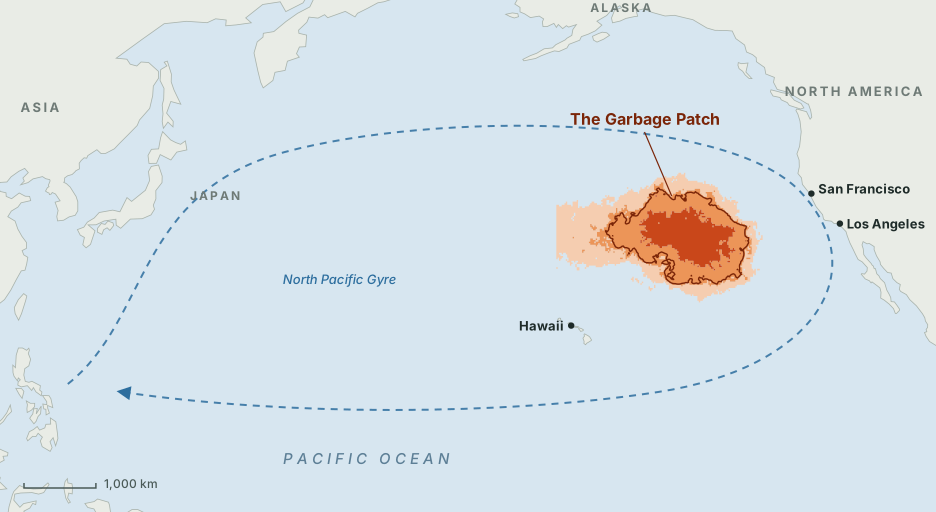
Not an island
You can't walk on it, and you can't see it from space. From a boat it looks like open ocean dotted with scraps, crates and tangled nets.
Spread very thin
Even in the densest part there is only about 0.2 grams of plastic per square metre of sea. The problem is how much sea it covers.
Far from anywhere
Its center sits nearly 2,000 km off California, in open water that belongs to no country, so no one government is responsible for it.
How much plastic is in any one spot?
Click or tap anywhere on the map to read the estimate for that spot. Drag to move around, and use the buttons to zoom.
Selected spot
Loading the map…
Model estimate of floating plastic of all sizes, 2015, on a grid of cells about 20 km across.
2 · How big it is
Three times the size of France
Counted by The Ocean Cleanup in 2015 and 2016 with ships, trawl nets and survey flights.
1.6 million km²
of ocean surface
About twice the size of Texas, or three times France.
80,000 tonnes
of floating plastic
As heavy as roughly 500 jumbo jets.
1.8 trillion
pieces of plastic
About 250 pieces for every person on Earth.
Put the patch over your part of the world
Drag the orange shape anywhere on the map, or pick a place. It is redrawn at true size wherever it lands, so it stretches near the poles just like the land does.
Now over: Its real home
For scale: about the size of Iran or Mongolia, 2.3 times Texas, 2.9 times France, or 6.6 times the United Kingdom.
Every net tow since 1972
Each dot is one sample: a fine net dragged along the surface, with its catch of small plastic weighed. Pick a decade to compare inside and outside the patch. Dots on the bottom row caught nothing.
Loading the tows…
| Decade | Tows inside | Typical inside | Tows outside | Typical outside |
|---|
Studies used different nets and routes, so single dots are noisy. Compare the typical values, and read the 1980s and 1990s loosely: very few tows were taken inside the patch then.
3 · What it is made of
Countless tiny fragments, and a lot of fishing net
Almost all of it is polyethylene and polypropylene, the light plastics used for bottle caps, crates, ropes and nets. They are lighter than seawater, which is why they float and collect here. These shares come from 1.1 million pieces caught in the survey's nets.
Count it, then weigh it
The same 1.1 million pieces from the survey nets tell two very different stories. Flip between them.
What kind of plastic, by number of pieces
How big the pieces are, by number of pieces
9 in 10
pieces are smaller than a grain of rice
These microplastics, under 5 mm, are 93% of the pieces but less than 1% of the weight.
Over half
the weight is in big objects
Items longer than 50 cm, mostly bundles of net, are just 1 in 1,700 pieces but 56% of the weight.
Sunlight
breaks big things into small things
UV light makes plastic brittle and waves crack it apart. It doesn't disappear; today's crate becomes tomorrow's fragments.
4 · Where it comes from
Writing from all around the Pacific
Language printed on 382 recovered objects. Much of it is fishing and shipping gear, so the language shows where an item was made, not who dropped it.